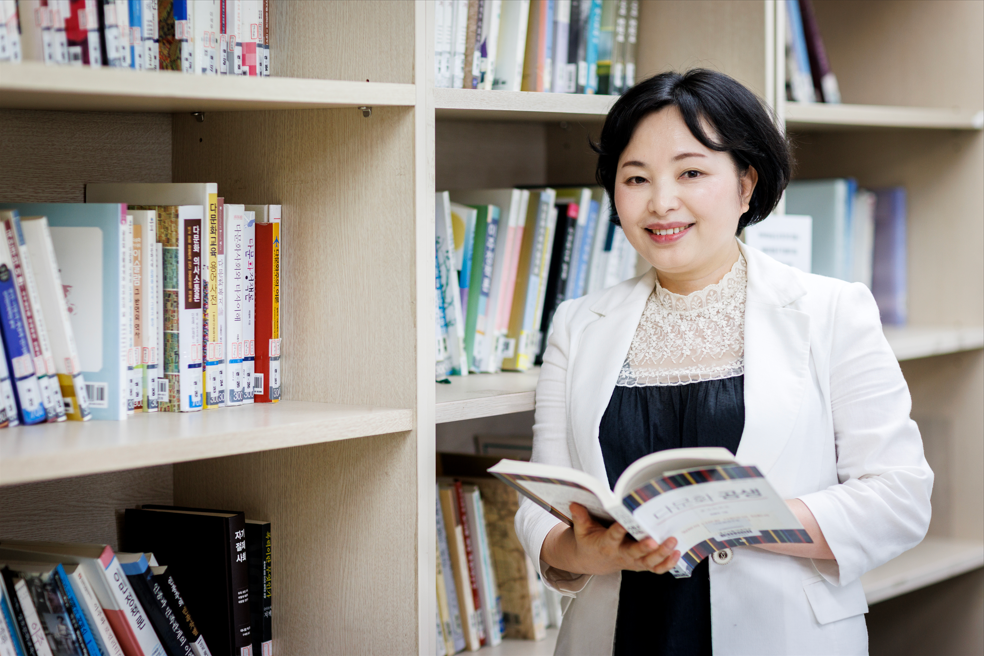
We traveled to Daegu to meet Choi Geum-hui, a familiar figure to many as a lecturer in Russian humanities. Several years have passed, and she is now the director of the New Bridge Research Institute, holding a doctorate in multicultural studies and continuing her path as a professional researcher. Here, we explore the story of her life.
Choi Geum-hui, originally from Cheongjin, Ham gyeongbuk-do, crossed the Dumangang River(Tumen River) and defected from North Korea in 1998. She lived with a Korean-Chinese family who sheltered her for eight years, during which she worked to support her family back in North Korea. Later, she crossed into Mongolia and applied for refugee status, eventually arriving in South Korea in 2007. In 2009, at the age of 35, Choi entered Kyungpook National University to resume the education she had given up while attending university in North Korea. She double-majored in Chinese Language and Literature and Russian Language and Literature. After graduating, she spent a year studying Russian at the Russian State University for the Humanities in Moscow. Upon returning to Korea, she worked part-time as a Chinese and Russian interpreter while enrolling in the graduate program in Russian Language and Literature at Kyungpook National University, where she earned her master's degree with a focus on Tolstoy's literature. She later went on to earn an MBA from Ajou University. Continuing her academic journey, she enrolled in the doctoral program at Daegu Catholic University and ultimately earned a doctorate in literature, specializing in multicultural studies.
Experiencing the Power of Language
We first asked her why she decided to study abroad in Moscow in 2011, bringing with her all she had-20 million won in savings. She recalled a tense moment while crossing the Mongolian border during her time in China, hoping to reach South Korea. At that critical moment, she couldn't risk speaking either Korean or Chinese. Just then, an officer arrived in a jeep and spoke to her in Russian. She managed to recall every bit of Russian she had ever learned and responded. She was able to do so thanks to her long-standing fondness for the language, though the experience left her with a lingering regret that she couldn't speak it more fluently.
Later, while majoring in Chinese Language and Literature at Kyungpook National University, that moment at the border stayed with her. She decided to double-major in Russian literature. While English tends to dominate in South Korea, she was determined to make the most of her strengths by focusing on Chinese and Russian. But once she began her studies, she realized the limits of her language skills. As she struggled, a sudden desire took hold-to go to Russia and learn the language properly. Without hesitation, she took all her savings and headed to Moscow alone. After about a year of studying abroad, she returned and once again took on the challenge of earning a master's degree.
In her first semester as a full-time master's student, she received an F. All the coursework, including the core textbooks, was in the original language, and translating the texts was only the beginning. That semester devastated her; she blamed herself for not being able to fully grasp the material. She barely managed to get through the first year, but having already invested so much effort, she decided to continue into the second. Although she eventually completed her master's degree, she hesitated to pursue a doctorate. Seeing a senior spend ten years struggling to finish their dissertation made her realize that further study would have to lead to financial independence-which only made the decision more difficult.
A Humanities Lecturer from the North
While weighing whether to start working or continue her studies, she took a philosophy course out of personal interest. One day, deeply immersed in both Western and Eastern philosophy, she attended a lecture interpreting The Analects of Confucius. "I remember feeling a shiver run down my spine during that lecture. The stories were so fascinating that I thought, Could I teach Russian literature-the subject I love-with this kind of depth and passion?
Later, at the suggestion of a gallery director in Daegu, she began offering an eight-month paid humanities lecture series. Those who attended her classes were amazed, saying they had never realized the humanities could be so engaging and enjoyable. In 2016, Choi appeared on the Thursday Special Lecture segment of Morning Forum on KBS, followed by appearances on MBC in 2017 and SBS in 2018, gaining recognition as a humanities lecturer. At one point, she gave as many as 35 lectures in a single month. Before preparing her lecture materials, she would read the original texts ten times and supplement them with her own reflections. Choi believes that "literature, alongside linguistic exploration, belongs to the realm of philosophy," and she continues to deepen her knowledge through regular philosophy study sessions. Her guiding belief is: "Even if only ten words remain after learning a hundred, keep on studying."
Becoming a Multicultural Studies Researcher
In 2022, while working on her master's degree, Choi participated in a research project at the Korea Women's Studies Institute. Through that experience, she discovered the appeal of academic research. Having completed a thesis of over 100 pages, she decided to pursue a doctoral program with research as her primary focus-seven years after earning her master's degree. Reflecting on her own life and developing a strong interest in the social integration of transnational migrants, she chose to study multicultural studies at Daegu Catholic University. Alongside her doctoral studies, she actively submitted papers to academic journals and sought out opportunities to present at conferences. She found that presenting allowed her to receive valuable feedback from scholars, helping her identify gaps in her work, refine her topics, and improve the quality of her research. By the time she graduated, she had presented at nine academic conferences. In the spring of 2023, Choi received an email from the National Research Foundation of Korea inviting applicants for the 7th World Humanities Forum. As a humanities lecturer, she diligently prepared a proposal titled "The Function and Role of Civic Humanities from a Social Integration Perspective." Due to the large number of applicants, the selection process was delayed, but she was eventually notified that her proposal had been accepted. With over 300 presenters and 3,000 citizens and researchers in attendance, the forum was a great success. The experience was immensely rewarding, and the feedback she received from professors during the discussion session significantly enriched her research.
Being selected for the Humanities and Social Sciences Research Program funded by the National Research Foundation of Korea was yet another piece of good news during the demanding days of preparing her doctoral dissertation. After completing her doctorate in 2025 and officially beginning her journey as a researcher, she remains actively engaged in new research projects.
Establishing the New Bridge Research Institute
As a North Korean defector herself, Choi Geum-hui founded the NewBridge Research Institute to bridge knowledge and practice by focusing on the lives and experiences of migrants, supporting their cultural adaptation and social integration. The institute aims to serve as a platform for research and education, working toward a society rooted in coexistence and shared growth with people from diverse migration backgrounds. Choi hopes to expand her research to reflect global trends, envisioning a Korean Peninsula where migration is viewed not as a cause for discrimination, but as a source of opportunity-and where integration is defined by coexistence, not assimilation.