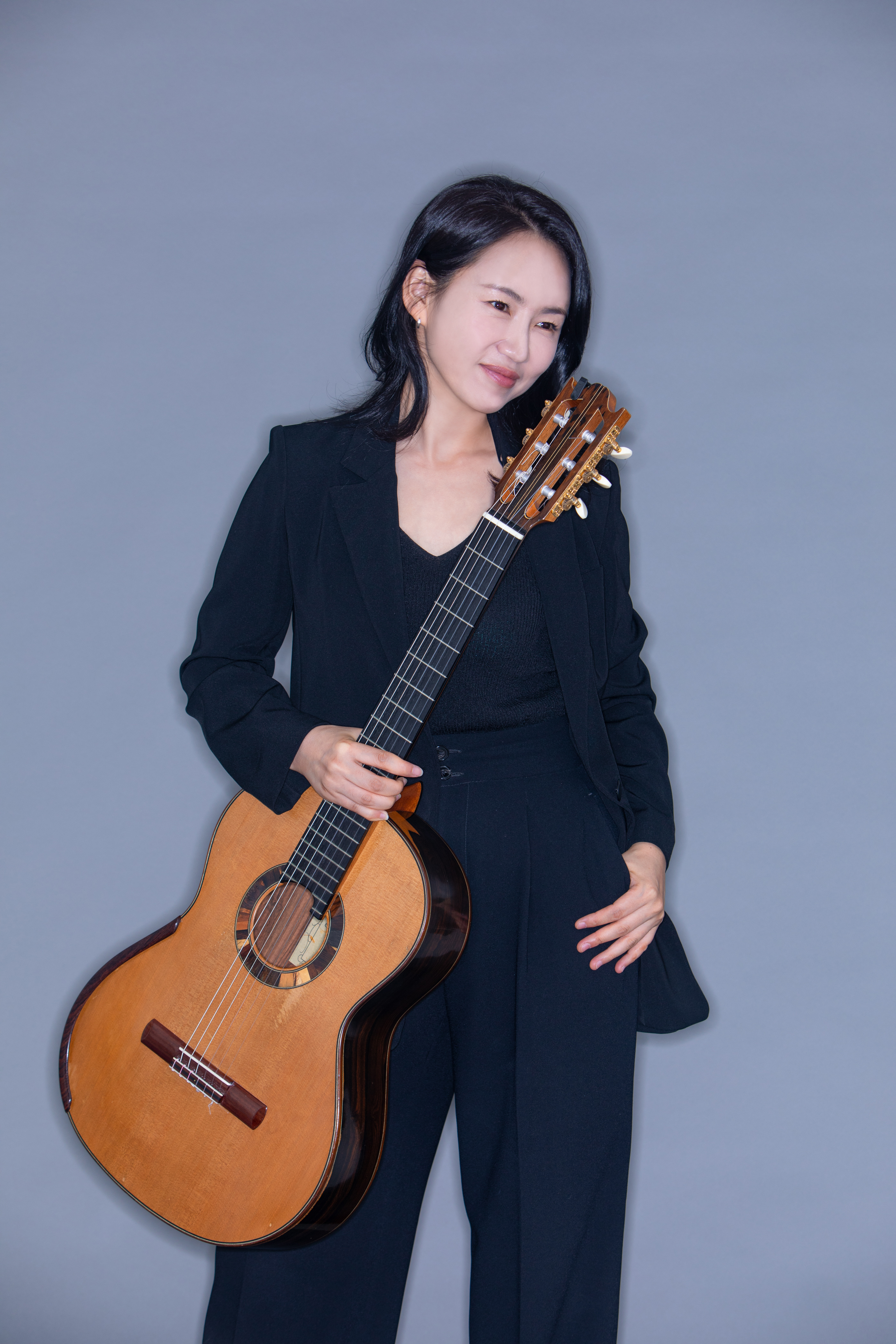
In 1987, in Hamhung, Hamgyongnam-do, the second daughter was born into a family of educators. From the moment she took her first steps, the little girl with dark, shining eyes was widely known as a born “dancer,” unable to contain her natural flair. Then one day, just before she was to enter elementary school, her father, who had always watched her talent with quiet pride, suddenly suggested that she try learning the guitar. Without knowing why, the girl took the guitar into her small hands, and thirty years later, she would gain admission to Korea’s leading arts institution, the Korea National University of Arts.
North Korean defector Yoo Eun-ji (38) is a guitarist in South Korea. She has completed the four-year program at the Korea National University of Arts and is preparing for her graduation recital. Behind the distinguished title of “the first North Korean defector guitarist admitted to K-Arts” lie years of hardship that shaped who she is today.
The Loss of Childhood Innocence
Eun-ji’s father was a professor who taught philosophy and classical Chinese at a university in Hamhung, while her mother was a homemaker who had once been a violinist. Born into an ordinary family, she loved dancing and took part in a kindergarten music class until the age of eight. She was a gifted performer who consistently won first place at provincial arts festivals. One day, her father attended a guitar performance and suggested that his daughter learn the instrument. She began studying the guitar naturally, and from that moment on, it became everything to her. Upon settling in South Korea, what Dr. Kim began was, once again, studying. Having defected without finishing middle school, she completed her high school education through the High School Equivalency Exam. But as Dr. Kim prepared for university admission, she found herself lost. In North Korea, there had only been one path—following one’s parents to the farm—but in South Korea, there were countless options. At that time, an overseas medical volunteer team was formed at her church. Dr. Kim joined but couldn’t help patients due to her lack of medical knowledge.
The year 1994, when she had just entered elementary school, was the time of the “Arduous March.” Children in the school music club were those with clear talent and families in relatively good financial circumstances.
“The hardest part was my lunchbox, my dosirak. My parents, who were so old-fashioned that they knew nothing about business, would eat thin porridge themselves yet always packed my lunchbox with white rice and precious eggs. Even as a child, once I understood our family’s situation, I felt ashamed and discouraged, and little by little, I stopped being childlike.”
Even in difficult circumstances, her parents’ commitment to education never wavered. In Hamhung, she honed her skills through private lessons with a highly regarded guitar teacher originally from the Korean community in Japan. Eun-ji’s dream was to attend a teachers college and become a music teacher. However, just before she graduated from high school, her father was taken into legal custody, and the family lost their home and fell into debt. Her plans to enter a teachers college came to nothing, but she was fortunate to be accepted into a two-year teacher-training program run by the province, leading to her employment as a kindergarten instructor. Despite her refined appearance, Eun-ji has been energetic since childhood. During her elementary school years, she always wore pants under her school uniform skirt and ran around the playground. If she was late, she would vault over the school wall without hesitation, a truly mischievous child. At nineteen, she became a kindergarten teacher, but over time she grew weary of the daily routine of sitting with children, cutting colored paper, and writing lesson plans in tiny handwriting. Then one day, a parent she was close to told her, “If you go to China, I can connect you with relatives living in South Korea, and you may be able to receive financial support.” That conversation became a major turning point in her life. Her grandfather, who lived in Hwanghae-do, was originally from South Korea. She vividly remembered him reciting his hometown address before his granddaughters, almost like a song, pouring out his longing. In the end, trusting the promise that she would be introduced to relatives living in South Korea through China, she secretly left her hometown at the age of nineteen and headed for China. What followed, however, was a story of hardship and upheaval too deep and long to be contained in just a few lines. The South Korean relatives she believed would be waiting for her in China never appeared, and as if by fate, she spent several years there living with her identity concealed. Five years later, in 2011, Eun-ji arrived in South Korea holding her young daughter’s hand. After completing her stay at Hanawon, she settled first in Daegu and soon enrolled at Keimyung College University. She could not bring herself to abandon the guitar studies she had continued in North Korea. Yet living as a college student and a mother in her mid-twenties was far from easy. She left her daughter at daycare, slung her guitar over her shoulder, and ran up the hills to campus. Without a single day off, she worked part-time jobs at restaurants and fried chicken shops. She was already struggling to stay afloat in the midst of life’s battlefield. There were days when she floated toys in the bathtub to keep her daughter entertained, while practicing the guitar in the bathroom. Even after graduating from college, Eun-ji’s pursuit of learning did not stop. “My time at Keimyung College University felt like a taste, just a beginning. I realized that if I wanted to study classical music properly, I had to go to the best arts education institution in Korea. That goal was K-Arts.” After that, she came to Seoul holding the hand of her seven-year-old daughter. Their first home was a semi-basement studio apartment of about 33 square meters on the outskirts of the city, rented on a monthly lease. She enrolled her daughter in a nearby school and began looking for a guitar academy. During a consultation, an instructor at the academy heard her goal and said, “K-Arts is not a place you can get into just because you decide to. I have never met someone this fearless.”
Life in Seoul, Starting from a Semi-Basement
There is a saying that when you avoid one hill, an even steeper one appears. Preparing for the K-Arts entrance exam was difficult, but living expenses and lesson fees were an even greater concern. Once again, she took on all kinds of part-time jobs, working at convenience stores, restaurants, and stocking shelves at E-Mart. However, hourly work brought in only limited income and offered no long-term stability. To secure a period of uninterrupted study, she needed not a steady monthly income, but a lump sum she could save at once. That was when she chose to work in packaging at Coupang. At six in the morning, she boarded a bus bound for Ilsan and spent the day packing boxes at a warehouse. The work was simple, filling boxes by checking order lists and placing items inside, but if she stepped away even briefly to use the restroom, boxes would pile up like a mountain, leaving her barely able to straighten her back. The only solution was to drink less water. Working eleven hours a day for two full months, she earned enough money to pay for several months of lessons. Before leaving home at dawn, she checked the meal she had prepared in advance for her daughter and the note she had written on a chalkboard, then quietly closed the door. Each time, her steps felt heavy as she thought of the daughter she was leaving behind.
“I knew I would pass.”
Compared to applicants who practiced 14 to 15 hours a day at private academies, the time available to Eun-ji was painfully limited. Balancing childcare, part-time work, and practice, her first attempt ended in rejection, almost inevitably. Her challenge to enter K-Arts, which began in 2015, finally bore fruit in 2018 with the word she had been waiting for, “Accepted.” What was striking was the response of the woman who made the impossible possible. “Before I even checked the results, I was already sure I had passed. I poured everything I’d prepared into that audition and put all of it on display. I knew there was nothing more to show and nothing left to prepare.” Even after passing the first gateway of admission, there was little room for ease in the life of a late-blooming college student. Classes and assignments left her with too little time to practice, while caring for her daughter, who still needed her mother’s attention, added to the strain. “When my daughter was young, no matter how busy I was, I made sure to read her picture books for at least two hours a day. I also tried to give her warm home-cooked meals instead of delivery food. I believe that a mother living her life doing her best is the best education a child can receive.” Asked what kind of person she hopes her daughter will grow into, she answers in a single sentence: “Someone who can look at the world with a warm heart.” Now a second-year high school student, her daughter remains her mother’s most dependable companion. As Eun-ji approaches graduation, her goal had been to enter graduate school and pursue deeper studies in the United States. For now, however, she has taken a brief detour. Excessive practice resulted in an injury to her hand. For a guitarist, fingers are everything. She has waited three years, but playing fast passages is still not easy. Yet in the midst of disappointment, she received an unexpected gift: a resilience strong enough to withstand any hardship. Her greatest wish is to live as a guitarist who can move hearts and offer comfort through her performances, and heal someone’s wounds through her own music. She also hopes to meet a life partner who will support her dreams and share a happy life with her.